


Cloud database storage
Manage your DuckDB database catalog in the cloud for easy scaling and collaboration.
Serverless analytics in your app, compatible with your existing Postgres stack.
Most engineering teams start customer-facing analytics on Postgres. It works until analytical queries fall over under load or pile up against the transactional workload and slow the product itself. Snowflake's cost model makes customer-facing workloads impossibly expensive. MotherDuck is a serverless analytical database with a hypertenancy architecture: every customer gets their own duckling — a dedicated compute instance against shared data — so analytical queries don't fight for resources and don't slow your product.
Every customer gets their own compute instance with full data isolation. No noisy neighbors, no over-provisioning, no shared cluster to tune. Heavy queries from one customer can't slow another — and a runaway query can't take down your product. New customer? Spin up a new duckling. No cluster sizing meeting required.
When you want analytics faster than a display refresh, the 1.5-tier architecture runs the same DuckDB engine in the user's browser and in the cloud. The dual execution query engine reclaims idle compute on the client to deliver zero-latency interactions. Our peer-reviewed paper on hybrid query processing was presented at CIDR: The Conference on Innovative Data Systems Research.
MotherDuck offers a Postgres endpoint, so you can point any Postgres-compatible client at MotherDuck via a standard connection string and get sub-second analytical queries — without rewriting your application logic, drivers, or ORMs. Queries that timed out at 60 seconds on Postgres return sub-second on MotherDuck. Keep the tools and languages your team already uses.
PostgreSQL is the default transactional database for millions of developers, and it excels at that job. It is not designed for analytics. Point your analytical workloads at MotherDuck through the Postgres endpoint and get a true columnar OLAP engine — without changing application logic.
MotherDuck leverages DuckDB’s pragmatic, friendly approach to SQL. DuckDB extends a Postgres style of SQL with syntax from other databases, so the migration feels familiar.
Sub-second cold starts let ducklings scale to zero between sessions. You pay per second, so a long-tail customer who logs in once a week costs effectively nothing. No clusters to size, no warehouses to suspend, no headroom to pay for. The bill tracks the work your customers actually do.
DuckDB is built from the ground up for analytical workloads with columnar vectorized execution. With MotherDuck, that small footprint delivers remarkable efficiency without complex infrastructure or configuration — and uses CPU and memory more effectively than any transactional database.
Embed live, interactive dashboards as Dives instead of building a charting layer from scratch. Drop in a customer-facing analytics agent on the MCP Server so your users ask questions in natural language on day one — no custom integration required.
Manage your DuckDB database catalog in the cloud for easy scaling and collaboration.

Efficiently run the same SQL queries on data stored locally, in MotherDuck or in your data lake.

Create fast data experiences by running DuckDB in the end user’s web browser with access to data hosted in the cloud.

Use idle compute on your laptop in concert with the cloud to increase speed and lower cost.

Use the web to browse the data catalog, write SQL, filter and sort results and share data.

Use with 25+ tools in the modern data stack for import, orchestration and business intelligence.
Serverless, per-customer compute
MotherDuck is a serverless analytical database with a hypertenancy architecture: every customer gets a dedicated DuckDB instance against shared data. The same engine can run in the browser via our Wasm SDK, giving you a 1.5-tier option when you want analytics faster than a display refresh.
Want to build an application that’s pure frontend JavaScript, with no backend to worry about? While DuckDB can run anywhere, including in the browser, MotherDuck’s Wasm SDK enables you to extend the speed of a local SQL engine to data persisted in the cloud. Using Wasm, client-side JavaScript processes data locally to enable analytics experiences that are faster than you can blink!
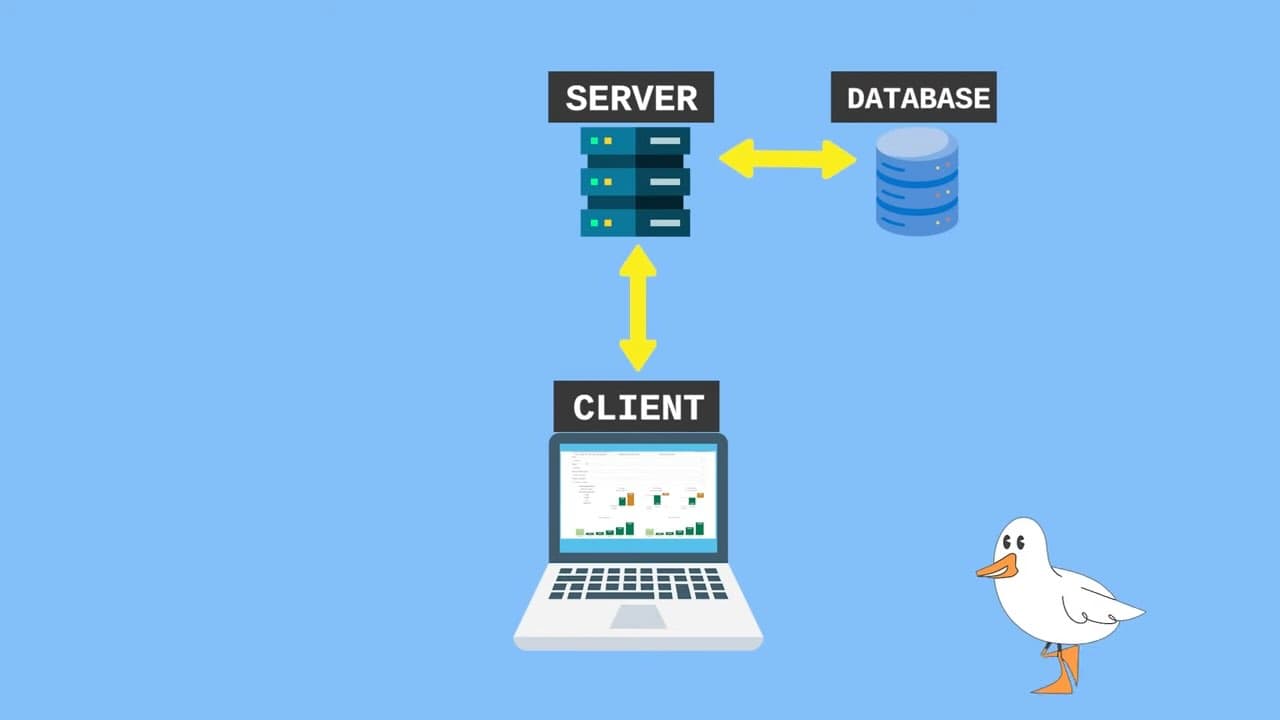
While a 2-tier architecture allows client-side applications to connect directly to the database, developer maintenance and overhead are only incrementally better...and you still don’t have the option to run your database locally.
A 3-tier architecture powers the vast majority of applications today. While it feels familiar, managing integrations and updates between the client, server, and database is time-consuming and unwieldy. For users, multiple steps between them and the data may slow down performance and speed at scale.
Modern Duck Stack